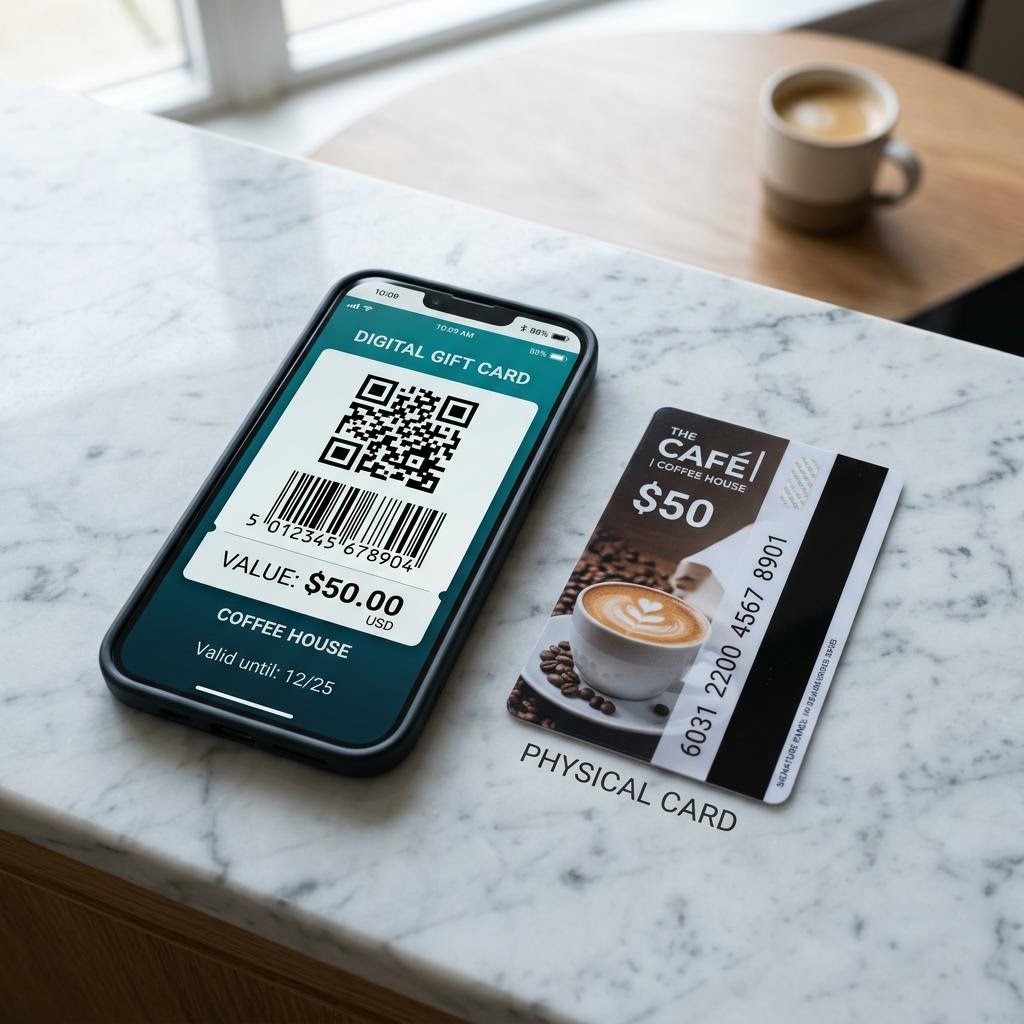
Fraud exposure runs in opposite directions
Plastic’s characteristic fraud is rack tampering. Cards sit unattended with zero balance, thieves record credentials and reseal packaging, and the card is drained the moment you activate it. This is a supply-chain attack, it happens before you own the card, and no care on your part after purchase prevents it.
Digital has no rack, so that entire category disappears. Its characteristic fraud is interception and copying — a code sitting in an inbox, forwarded through a chat, or read during an account compromise. That is an attack on your handling, which means it is largely within your control in a way rack tampering is not.
Delivery reliability favours plastic
A card bought in a shop is in your hand. Nothing else has to work. Digital delivery depends on a correctly typed address, a mail provider that does not filter it, and a fraud-screening system that does not queue the order for manual review — and that review can take a day or more on exactly the orders people place in a hurry.
Mistyped addresses deserve particular emphasis because the failure is silent and unrecoverable. A wrong digit sends a working credential to a stranger who will never mention receiving it. Plastic has no equivalent of a typo that quietly hands your money to somebody else.
Recoverability is bad on both, differently bad
Neither product gives you the statutory dispute rights you have on a debit card, because gift products are carved out of those rules. What you have in both cases is the issuer’s discretion, exercised more generously when you can produce evidence.
For plastic, that evidence is the receipt and the packaging, and a tampering claim is plausible enough that some issuers honour it. For digital, it is the order confirmation and delivery timestamp, and a claim that a code was intercepted is harder to distinguish from a claim you spent it yourself. Slight edge to plastic, and only if you kept the receipt.
The practical differences that decide it
Digital wins outright on speed when it works, on distance, on not being lost in a drawer, and on the small but real advantage of arriving with a redeemable balance rather than requiring activation. It is the correct choice for a remote recipient and for anything you can redeem into an account immediately.
Plastic wins on presentation, on giving to someone who is not comfortable managing codes, on being usable without a phone or a working inbox, and on not depending on an email address you might have wrong. It is the better choice for an in-person gift and for older or less technical recipients.
The rule that resolves most cases
Choose digital when the value will be redeemed into an account within a day or two. Choose plastic when the card will be handed over physically and spent reasonably soon. The bad combinations are the ones to avoid: a digital code held unredeemed for months, and a plastic card bought off an unattended rack without inspection.
Both products punish holding. Whichever you pick, the dominant variable is not the format — it is how long the value sits unspent. That single factor outweighs every comparison above.